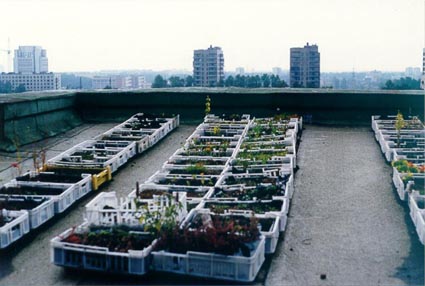
 |
| St Petersburg rooftop.Image source. |
Showing posts with label TERRITORIES. Show all posts
Showing posts with label TERRITORIES. Show all posts
10 January 2012
Urban Gardening in St Petersburg, Russia
Environmental activism in post-soviet
Russia used to be the country’s most dynamic and effective forms of social
activism. In contemporary Russia, however, activists face severe obstacles in
promoting green issues. The Saint
Petersburg Urban Gardening Club, founded as early as 1993, is still
struggling with the authorities’ acknowledgments of its important work.


16 December 2011
International Public Space Library
 |
| Image source |
 |
| IPSL book (source) |
The International Public Space Library’s (IPSL) ambition is to offer
books for free in public spaces all around the world. Soft-launched in
September 2010, under the light of the recent occupy movement the experiment
has gained new topicality. Unlike
a traditional library, the IPSL has no physical building or location. Each one
of the books, anonymously donated, contains an IPAL label and are left in
public spaces, free to pick up. Readers are encouraged to return the book after
reading to the library by placing it at another space.
Anyone can donate a book to the IPSL
collection. Just download a PDF copy of the IPSL ex libris here or download the image
below, print and affix it inside the front cover of the books you want to share
and spread them (but make sure they don’t get wet). With more publicity this project potentially is able to build up the greatest library of the planet and fromulates a challenging growing spatial configuration of a library consisting of connections and movements of books. "Libraries are not made; they
grow." (Augustine Birrell
(1850-1933), Chief Secretary of Ireland)


During the just started 7-day growing exhibition on Strategies for Public Occupation by the Storefront for Art and Architecture, the IPSL will launch a temporary ‘pop-up’ branch. This temporary library will offer a selection of books to help stimulate the ongoing public discussion of economics, politics, society and culture that may be reflective of the Occupy Wall Street movement and other social movements that have been or are currently powered by the free exchange of ideas, particularly through the sharing of books. At Liberty Plaza (Zuccotti Park) the occupiers established The People’s Library with a collection of more thatn 5500 books, unfortunately most of them got missing after the police raid to clear the park in November.
26 November 2011
Manuel Castells: The Crisis Always RingsTwice
Yesterday, sociologist Manuel Castells was giving a lecture at Tent City University at Occupy LSX entitled "The crisis always rings twice: from financial crisis to fiscal crisis to political crisis".
24 November 2011
Is Britain becoming Los Angeles?
Recently the architect Richard
Rogers attacked the British government’s planning reforms and warned that
Britain could 'very easily' become to resemble the ghettoes of Los Angeles with
'rust belts and towns joining each other'. Cities such as Birmingham and Milton
Keynes, Bristol and Bath would also begin to merge under the current prospect
of the policies and foster an enormous sprawl. Rogers argues that 'cities are
the engines of the economy, the heart of our culture and places of innovation.
If the framework is not greatly improved it will lead to the breakdown and
fragmentation of cities and neighbourhoods as well as the erosion of the
countryside.' Until now the fears over the plans had been limited to the
countryside. Rogers is the first person to voice concern about the effect upon
major cities, as the Mail online article tells. Instead of uncontrolled
planning, Rogers pleads for the re-development of derelict areas and buildings
in the inner cities. I would doubt
that Lord Rogers also had in mind the benefit cuts that result in an exodus of
inner-city working class people to the city’s fringes, as discussed in my
recent post. Maybe I do him
injustice, but I would have reasons
to believe that he is not (always) thinking of re-developments that benefit
the socially and economically disadvantaged.
15 November 2011
Ulan Bators ‘Ice Shield’ to Influence Summer Climate
As a result of global warming Mongolia’s
capital Ulan Bator suffers from unbearable hot summers caused by the so called
the urban heat island effect. Mongolia’s
government is about to launch a bold project to influence the summer climate in
their capital as the
guardian reports today. In giant blocks of ice geoengineers intend to
“store” sill freezing winter temperatures that will aid to cool and water the
city as it slowly melts during the hot summer months. It will be tested if the city gets cooled through the ice in
summer and how much energy-intensive air conditioning can be reduced.
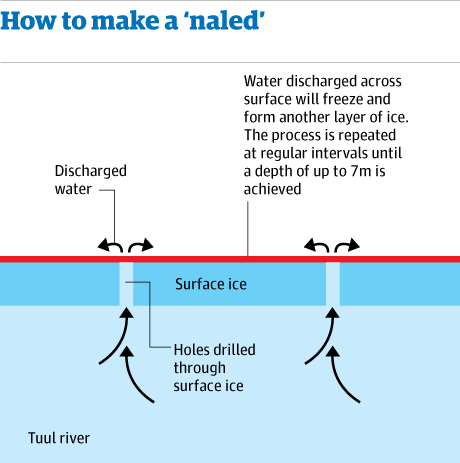
Specifically, the idea of the project is to
artificially create “naleds”.
Naleds are thick slabs of ice that naturally can be found in far northern areas
when rivers push through cracs in the surface to seep outwards during the day
and then add an extra layer of ice during the night. Through this process these
layered ice slabs continue to grow in thickness as long as there is enough
water pressure to penetrate the surface. Due to their thickness of more than 7
metres they melt much later than regular ice.
 |
| image source |
The climate manipulating project tries to
recreate this process by drilling bore hole into the ice that has started to
form on the Tuul river. The water will be discharged across the surface adding
a new layer of ice on top. The drilling will then be repeated at regular
intervals throughout the winter.
Robin Grayson, a
Mongolian-based geologist argues that "if you know how to manipulate them,
naled ice shields can repair permafrost and building cool parks in
cities."
While naleds have served industrial
applications before, as military bridges in North Korea or as platforms for
drilling in Russia, the Ulan Bator climate experiment is unprecedented.
This giant project lines up with other huge
climate manipulation projects like the rain
control operation for the Olympics by the Beijing
Weather Modification Office.
4 November 2011
"Bundled, Buried, and Behind Closed Doors"
mammoth recently pointed at this documentary short by Ben Mendelson and Alex Chohlas-Wood portraying the telco hotel at 60 Hudson Street in Manhattan. The former hotel is now a huge internet hub and, as the documentary speculates, may be an "outpost of a global empire". Within the physical infrastructure of the internet, 60 Hudson Street shows facinatingyly the "tendency of communications infrastructure to retrofit pre-existing networks to suit the needs of new technologies". Amongst Mendelson's and Chohlas-Wood's interviewees are Saskia Sassen as well as Stephen Graham whom we know well for his contributions on military urbanism and splintering urbanism.
16 February 2011
Mapping The Crime

Last week police.uk launched a map of every single crime recorded in December last year in England and Wales. The phenomenal reaction to the launch caused the crashing of the website. With a resolution down to the street level everyone is now able to track the safety of their neighbourhood. Updated monthly the maps can be filtered according to different sorts of crimes and even Anti-social behaviour incidents are mapped. I wonder what impact this has on for example real estate prices or neighbourhood watching. If you're looking for a flat wouldn't you check the crime map before? Policing Minister Nick Herbert said the Government was determined to provide as much detailed information as possible. "We can't sweep crime under the carpet," he said. "We have to tell the truth about crime and where it is happening and give the information and the power to the public." Apart from informing the public, access to this data might also fuel fear and the suspicion and mistrust to your neighbours. It even might be possible to identify crime victims due to it's accuracy.
In response to the crash of the website the guardian launched their own map with the feature of comparing different areas and crimes .
17 August 2010
Weather = Energy
 In the amazingly beautiful competition entry for the Land Art Generator Initiative by Paisajes Emergentes and Lateral Office weather is used to create energy.
  Read an extract of the team's project statement:
The rest of the statement can be found on their flickr page.WeatherField is a shape-shifting energy generation park along a strip of sandy beach in Abu Dhabi between Yas and Saadiyat Islands. The park is an open public space and is capable of harvesting the abundant renewable energy resource of wind within the Middle East context. The public park offers a variety of ways to engage with climate and renewable energy, as an economic sponsor, as a visual or physical experience, and as information.
Unlike current renewable energy fields where technologies are publicly inaccessible, static, and always on, WeatherField offers a range of public engagement dependent upon wind, sun, and moisture. Energy generation becomes a public performance, dynamic, reactive, and interactive. The park is active when weather events are active, and calm when weather is calm, in each instance offering the public a compatible experiences.
Paisajes Emergentes: Luis Callejas, Sebastián Mejia, Edgar mazo, Alexander Laing
Lateral Office: Mason White, Lola Sheppard, Matthew Spremulli, and Fei-Ling Tseng.

 Of course, a high efficiency of the proposal is questionable. But in my opinion the real quality lies in the aesthetic statement of the land art project and, as well, that the ground and aquatic ecology is almost undisturbed.
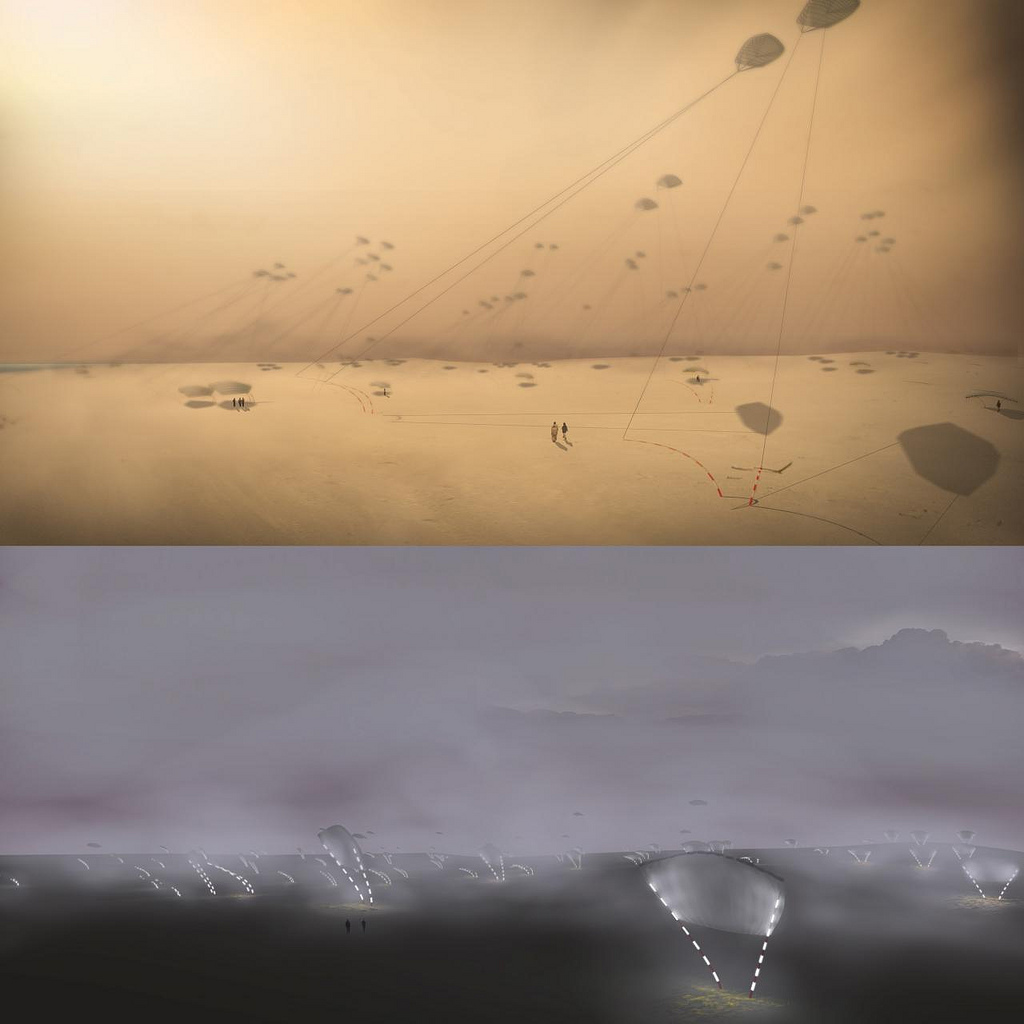 :: source of all images
In the archives:
Wind Energy Replaces Oil From The Gulf
Wind Of Change
Hydro Visions
16 August 2010
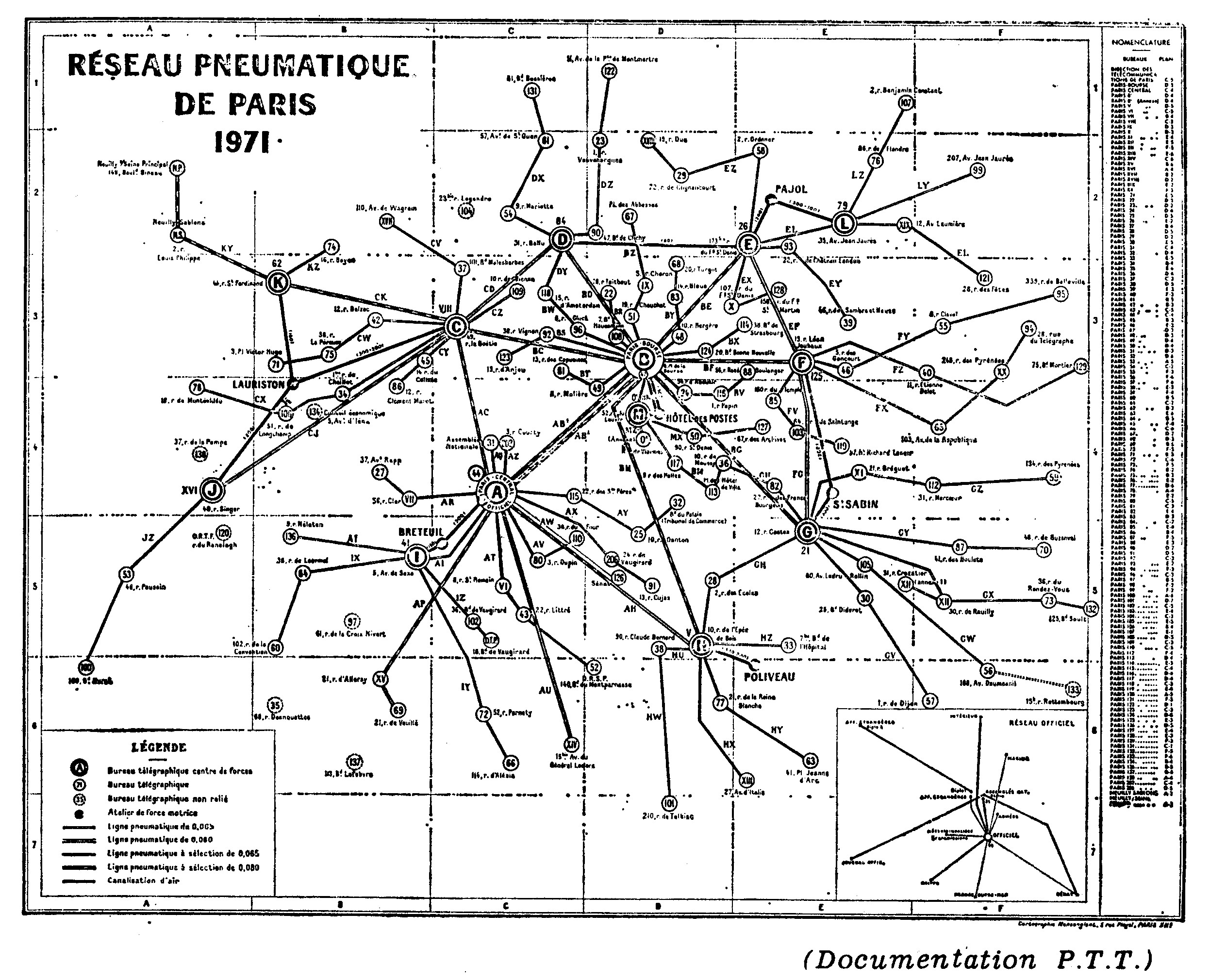
Pneumatique
 :: Paris, image source
Pneumatic post or pneumatic mail is a system to deliver letters through pressurized air tubes. It was invented by the Scottish engineer William Murdoch in the 1800s and was later developed by the London Pneumatic Dispatch Company. Pneumatic post systems were used in several large cities starting in the second half of the 19th century (including an 1866 London system powerful and large enough to transport humans during trial runs - though not intended for the purpose), but were largely abandoned during the 20th century.Recently I came across this interesting text on the pneumatic post in Paris. A major network of tubes was in use until 1984, when it was finally abandoned in favor of computers and fax machines. This invisible network under the city is highly fascinating in terms of its size and capacity. For example in Paris the peak was in 1945 where 11.271.228 deliveries were sent through the 467 km long tube system.
 :: Rohpost Berlin 1885, image source
 :: Damages on Berlin's pneumatic post after WW II, image source
Also Berlin sustained a pneumatic system called 'Rohrpost' of 400 km until the years 1963 (West) and 1976(East).

 :: Prague, image source
In Prague, in the Czech Republic, a network of tubes extending approximately 60 kilometres in length still exists for delivering mail and parcels. Following the 2002 European floods, the Prague system sustained damage, and operation was mothballed indefinitely.
 :: New York City's pneumatic subway in 1870, image source
New York City even had a pneumatic subway in the 1870s. Over 400,000 New Yorkers took a joy ride underground during the three years the pneumatic subway was open for demonstration. In 1873 , a stock market crashed killed financial support and thus the extension of the pneumatic subway.
18 June 2010
YUKON MISSISSIPPI DANUBE - MEANDER


8 July 2009
GIBELLINA II
 :: image via Flickr user charlesbegniamino
Thanks to a post by mammoth this is a follow up to Synchronicity's Gibellina entry from May with links to awesome pictures of Alberto Burri’s Grande Cretto and the other artworks of Gibellina.
Grande Cretto
Gibellina 1
Gibellina 2
Gibellina art
In the Archives: Gibellina
31 May 2009
TRAFFIC!

The French writer and philosopher Jean Baudrillard once wrote of the freeways of Los Angeles as being "ideally suited to the only truly profound pleasure, that of keeping on the move." Indeed, nowhere is the pleasure of keeping on the move more profound than in a city whose freeways rarely offer it.Architecture photographer Benny Chan documents Los Angeles' traffic problems. Shot over a few years during various helicopter trips, the photographs give information about the extents of LA's car problem.


 :: images and quote via GOOD Magazine
Subscribe to:
Posts (Atom)