Pages

Showing posts with label SPATIALITIES. Show all posts

26 March 2012

Urban Informality - A Railway Market in Thailand

Marketers waiting for the train to pass. (Image source)
The Mae Klong Railway Market is an amazing example of the city as a symbiotic adaptive organism. During my research on informal markets I came across the market in the city of Mae Klong, 70 km outside of Bangkok for the first time. After some research I realised that the videos for the market have been quite successful YouTube hits. But as I could only find entries on travel blogs and travel magazines I decided to pick it up and share it herewith. In case you haven’t seen the videos do check them out below.
Mae Klong Railway Market is known as Talad-Rom-Hoob (dtà-làat rôm hùp ตลาดร่มหุบ) in Thai which translates something like collapsible shady market. The name refers to the distinctiveness of this market: located directly on and next to the railway tracks, once the train arrives the marketers pull back their awnings and umbrellas to let the train pass. Immediately after the train has passed the market gets reconfigured and the sales continue. The only indicators of the spectacle are the train tracks which are then used as the circulation food paths of the market.


16 March 2012

Two Tales of Mass Housing in Marseille - La Tourette and La Rouvière

In the previous post I have already pointed out that Marseille is somewhat different from other French cities when it comes to mass (social) housing. Through their spread of grands ensembles all over the city, ghettoization of the poor is limited which furthermore might be part of the reason why Marseille was not so much affected by uprisings and riots in recent years despite the cities diverse population structure.
As the second Marseille post I would like to juxtapose two typical housing situations of the city: One is the ensemble of La Tourette in immediate proximity of the Old Port in the city centre and La Rouvière on the city’s fringes of the southern mountains.

8 March 2012

Marseille – An Integrative Model for Inner-City Social Housing?

Unlike other French cities, Marseille’s socio-spatial structure is distinctively different from a prevailing concentric centre-banlieue urban landscape with outwardly growing poverty, crime, and social segregation. Might this specific socio-spatial distribution be a model to diminish social tensions?
In the hometown of Corbusier’s famous first machine for living the geographical situation as the closest harbour for North-African immigration caused high demands in housing supplies. Therefore, and also as a consequence of vast bombings during WW II, numerous grands ensembles (housing estates) and housing blocks had to be erected in the city in the second half of the 20th century. As a result the whole cityscape is interspersed with huge concrete estates and tower blocks.

22 February 2012

Everyday Creativity – Community Gardens at Tempelhof Airport in Winter

A recent winter walk at the former airfield of Tempelhof Airport in Berlin also took me to the Allmede-Kontor plot where community gardens are located between the former runways. At the snow-covered airfield urban garding obviously has come to a halt. But the creatively and tenderly assembled nests of the community gardeners wait to be re-cultivated in spring, which is hopefully soon to come.
Meanwhile I’d like to share these pictures as examples of everyday creativity. These spaces of vernacular creativity are examples that emphasise the role for non-economic and non-productive values and practices in shaping processes of urban creativity. They foster a rethinking of the ‘Creative Class’, a terminology that usually does not encompass these kinds of spaces who are created by local residents of any classes. 

17 February 2012

This Ain’t California – Skateboarding and the City in the GDR

Skateboarding at Alexanderplatz. Film still ‘This Ain’t California’
Public space in the GDR was - as in many other autocratic societies - understood as a means of political representation of the regime. The occupation of East Berlin by the USSR and the foundation of the GDR also entailed a radical change in the configuration and understanding of urban public spaces. One of the foundational principles of the GDR was overcoming of previous epochs, which also influenced urban planning and the built environment. As a first measure, the demolition of buildings that had been closely associated with Prussia should make space for the new regime. Therefore buildings like the Berlin palace (Stadtschloss) and Schinkel’s Bauakademie needed to give way for public spaces as sites of organised mass events. East Berlin got rebuild as the ’centre of a representative publics’, a space of self-staging. Moreover the built environment should represent the collective thinking of the socialist state through grand gestures of buildings beyond human scale provoking humbleness in its citizens. The individual was subordinate and rendered small under the overwhelming influence of the state. With grand axes and vast open spaces, East Berlin’s new city centre should appear as one continuous space. Alexanderplatz, the space around the impressive new TV Tower was designed as one continuous concrete surface that should later become a heaven for skateboarders.

8 February 2012

Double Fake - Imitations at Berlin Potsdamer Platz

At times of the Berlinale film festival, one heads out to Berlin Potsdamer Platz quite frequently. I recently took a couple of pictures of the remains of the potemkin village in the heart of Berlin's inner city. 
The building and its fake twin. 2012. (Image by SYNCHRONICITY)

2 February 2012

Anagram Urbanism - Re-shuffling the City

Jellyfish Theatre London 2010 (image source)
When skimming through my notebook today, I got reminded of a lecture by German artists Köbberling/Kaltwasser back in November at the University of the Arts Berlin. The artists were presenting a series of projects and urban interventions in public space under the subject of considering the city as anagram. Their site-specific interventions use locally sourced materials that are transformed into object-like architectural constructions. Characteristically, the appearance of those constructions is imperfect and unfinished. After the destruction of the installations, objects and houses, the materials the artists have been using, disintegrate in the materiality of the city again.

27 January 2012

Container ‘Mall’ – An Example of Urban Informality in Odessa

all images taken from the amazing series by Ukrainian photographer Kirill Golovchenko
The 7KM Market is probably Europe’s most extraordinary market, partly with the air of a bazaar, partly post-soviet retail eldorado, it mainly consists out of shipping containers. Its atmosphere has nothing in common with the recently opened shipping container pop-up shopping mall in East London - but probably has been inspirational thereof.

25 December 2011

Happy Holidays with a Bunch of Urban Readings

The architecture typology of the year 2011 is the tent, via Urban Affect
SYNCHRONICITY is also going on holidays. Meanwhile, here are a couple of suggested reads/links:


Allison Arieff writes on pop-up urbanism. City of Sound elucidates what cites and neuroscience can learn from each other. Peter Frase imagines four futures of capitalism after OWS, whereas Al Gore and David Blood imagine a sustainable capitalism. Also check out this interview with Thomas Balsley as the person who has designed more POPS (Privately Owned Public Spaces) than anyone else in New York City. Hito Steyerl on art as occupation. The economist explains the strange but extremely valuable science of how pedestrians behave. And finally, in this archive designers list their 3 favourite buildings.

I hope everyone is enjoying their holidays, and see you back in the new year! And check out my twitter page for more regular comments.

6 December 2011

The City As A Palimpsest: Teufelsberg

+52° 29' 49.89", +13° 14' 27.64"

Strolling around Berlin is not a journey through history it is the simultaneous experience of various histories. Ergo, many urban theorists refer to the city of Berlin as a palimpsest.
Recently, lured by a sunny autumn Sunday, I took a long walk in West Berlin’s Grunewald – The Green Forest. At 3000 hectares it is the largest green area in the capital. With its old oak trees no one would expect a rich history on this site – if it wasn’t Berlin. Out of the flat sea of trees raises the Devil’s Mountain – the Teufelsberg - 80 m above the level of the surrounding and completely flat Grunewald. The Teufelsberg is one of the highest elevations in the city. I approached the site from S-Bahn station Heerstraße, the north-eastern part of the Grunewald.

3 November 2011

Metabolic Architecture Repairing Itself

Image source
Protocells are able to help building bottom-up materials that form a living architecture. A quite bold claim by Rachel Armstrong from the Bartlett  in this, admittedly not very current, TED talk.
 
At the Bartlett, she is specialising in non-Darwinian techniques of evolution and the challenges of the extra-terrestrial environment. Armstrong is summarising that their research intends to generate, 
"metabolic materials to counterpose Victorian technologies [to build up] architectures from a bottom-up approach. Secondly these metabolic materials have some of the properties of living systems, which means that they can perform in similar ways. They can expect to have a lot of forms and functions within the practice of architecture. And finally, an observer in the future, marvelling at a beautiful structure in the environment, may find it almost impossible to tell whether this structure has been created by a natural process or an artificial one"
In her talk she suggests that it might be possible that Venice repairs itself. Let's hope that this amazing city will not sink before the protocells are ready to petrify the wooden piles it is build upon.

13 October 2011

Occupy Wall Street - The community and their clearing


Filmmaker Alex Mallis gives insight in the protesters' everyday life. Only in a few weeks time OWS formed a remarkable community with highly developed infrastructures at Zuccotti park. Amongst the most obvious of the emerged infrastructures are food provision, personal hygiene, and sleeping camps. Moreover the protesters also initiated a highly developed media centre at the square, with electricity from gasoline powered generators. Furtheron they have organised their own health-care with sponsored medication, and as well - since protesting and sleeping on the concrete floor has implications on the protesters' body - a massage studio. Collective cigarette rolling and musical entertainment are also amongst the activities and services the occupation of Zuccotti Park provides. Watching the short documentary very much brings into mind how informal settlements in other cities of the world work. Strinkingly, the OWS protesters generated a thriving urban space in a remarkable short period of time. What sets the OWS space apart from other informal settlements is that the mainly young protesters can tap into recources that less medialised communities are not able to access. The internet and even the installation of a shipping address (The UPS Store, Re: Occupy Wall Street, 118A Fulton St. #205, New York, NY 10038) has supported the rapid infrastructural development at Zuccotti Park.

After it was announced that the police will be clearing the privately owned public space of the protesters so that the parks owner can clean and do repairs, OWS has mounted an online effort to get the resources they need to clean up the park themselves before the police will take action on friday. The single proper reaction to this announcement. OWS is asking people to donate brooms, lots of brooms, mops, squeegees, buckets, waste bins, dust pans, trash bags, and they could use some power washers too either to bring them to the plaza or to ship them to their address (via amazon possibly).
In course of the announcement of the clearing of the plaza the letter from the park owner Brookfield Properties to NYPD leaked yesterday. Unsurprisingly they no longer tolerate the occupation. Their reasons are mainly circulating around that the 'public space' has to be clean and neat to be able to serve the local population again - which in fact are the Wall St brokers (who also were sending complaints to the owner). Hence cleanliness and locality might overcome freedom of political expression with potentially massive impact. And NYC Mayor Bloomberg approves. We are waiting with bated breath what will happen.

Finally, here is a link to the transcript of Slavoj Zizek's recent speech at Zuccotti Park.


Postscript Oct 22: The clearance of the park could have been prevented. Here is a link engaging as well with the community that evolved since the start of the occupation of Liberty Plaza: It tells us more about the barbers, cigarette rollers and other volunteer workers.

8 October 2011

Occupy Wall Street - Zuccotti Park

Zuccotti park during the Occupy Wall Street protest. Image source.

Zuccotti Park in Manhattan's financial district has become the locus for the Occupy Wall Street (OWS) protests in the last few weeks. Protesters have gathered, prostested and camped out there to make their demands visible in public. Yet, in contrast to other recent social movements the site of protest is not a public space in its common sense. Zuccotti Park is privately owned, named after a real estate development lawyer who has been active both in governmental affairs and in private development. The park, which is actually a paved plaza, is owned by Brookfield Properties, in conjunction with its ownership of One Liberty Plaza, the adjacent high-rise commercial tower. Arguably the park is a privately owned public space, a quasi public space that is so common in city centres of the great capitalist cities. Nevertheless, and interestingly, the space is still a site to enact democratic action.
OWS's spatial setting is different than those of other urban movements like the arab spring which is closely connected to Tahrir Square for example. OWS' site was chosen deliberately due to its symbolic character, as being right in the middle of New Yorks financial district. The occupation of Zuccotti park IS already the occupation of a piece of Wall Street.
Besides, the park has quickly become a tourist attraction.
Also Peter Marcuse has written a worth reading comment on the protest.
Zuccotti park after the post 9/11 refurbishment. Image source.

16 February 2011

Mapping The Crime


Last week police.uk launched a map of every single crime recorded in December last year in England and Wales. The phenomenal reaction to the launch caused the crashing of the website. With a resolution down to the street level everyone is now able to track the safety of their neighbourhood. Updated monthly the maps can be filtered according to different sorts of crimes and even Anti-social behaviour incidents are mapped. I wonder what impact this has on for example real estate prices or neighbourhood watching. If you're looking for a flat wouldn't you check the crime map before? Policing Minister Nick Herbert said the Government was determined to provide as much detailed information as possible. "We can't sweep crime under the carpet," he said. "We have to tell the truth about crime and where it is happening and give the information and the power to the public." Apart from informing the public, access to this data might also fuel fear and the suspicion and mistrust to your neighbours. It even might be possible to identify crime victims due to it's accuracy.
In response to the crash of the website the guardian launched their own map with the feature of comparing different areas and crimes .

27 January 2011

Militant Modernism

Berlin Hansaviertel

During a recent research I came across to an incredible collection of vintage postcards depicting mostly modernist buildings in Germany, France and the Netherlands. The postcards mainly dated from the 50s, 60s and 70s show less known modernist structures in a sometimes almost romantisising manner. Advertising the new way of living, nowadays the depictions appear less unattractive for a general viewer. Taufkirchen close to Munich

Lelystad Kantoorgebouwen

The failure of many modernist housing induced a trend towards building of diseneyfied pre-industrial public housing. This trend is especially apparent in Great Britain. In Prince Charles' experimental town Poundbury designed by Leon Krier and built in the 1990s the houses follow a pastiche of various traditional anti-modernist styles. In strong opposition to these developments is Owen Hatherley's book Militant Modernism, a manifesto for a rebirth of socialist modernism. As the Guardian reviews: 'Hatherley's book is an intelligent and passionately argued attempt to "excavate utopia" from the ruins of modernism'. The book refers to built and un-built examples of the Smithons, the Park Hill estate in Sheffield, Heygate in London or the Bevin Court designed by Tecton. Apart from the the chapter of the industrial and brutalist aesthetics in Britain, Hatherley references Russian Constructivism in architecture, the Sexpol of Wilhelm reich in film and design and the alienation effects of Brecht and Hanns Eisler on record and on screen - all aruing for a Modernism of everyday life. As written on the book cover: 'This book is a defence of Modernism against its defenders (...) it attempts to reclaim a revolutionary modernism against its absorption into the heritage industry and the aesthetic of the luxury flat.'

Royen

Royen

Royen

Royen

Pratteln

Montelimar

Ludwigshafen

Berlin

Montepulciano


All Images by Hansaviertel

7 September 2010

Biennale Review

'The first decade of the 21st century is ending in a succession of radical changes. In this context of rapid evolution, can architecture be the mouthpiece for new values and modern lifestyles? The 2010 Biennale is the opportunity to test architecture's numerous possibilities and to account for its plurality of approaches. Every one of its orientations relates to a different way of living.'

Director Kazuyo Sejima's statement - by the way the first woman to direct the Architecture Biennale - resulted in the less pretentious 12th International Architecture Exhibition in the absence of 'Lynnadids'.
In the previous editions of the exhibition the vast and beautiful spaces of the Corderie dell'Arsenale used to act as a mere background for sculptures of 'Star-Architects'. This year the installations refer directly to their sourrounding and create a series of diverse and interesting spaces. Probably the most beautiful and definitely the most poetic of these spaces is Matthias Schuler's (Transsolar) and Tetsuo Kundo's Cloudscape.
An artificial cloud hanging between the columns which could be gradually experienced through a lightweight spiral ramp. You enter the cloud from cool and dry climate underneath until the cloud fully embraces you. When reaching the top the climate gets warm and dry and sight becomes clear. The cloud is generated through different pressures of air.::image source

Canadian artist Janet Cardiff's sound installation 'The Forty Part Motet' is intangible. In the early modern hall under the wooden pitched-roof a choral of Thomas Tallis (1514-1585) hangs in the air. 8 x 5 speakers - arranged in an ellipse - distribute Tallis' 'Spem in alium'. Forty vocal scores expand the space and create a touching experience of the space.
Both installations deal strongly with the experience of space and its physiological and psychological impact on the human body.

The second main exhibition at the Palazzo del Esposizioni as well showed a heterogeneous overview of contemporary architecture production. Next to known offices from Japan like Atelier Bow Wow, Sejima's SANAA and Toyo Ito Biennale proved Aranda/Lasch as well as many young practices showed their conceptual approaches - few of them really outstanding but as a whole a highly informative cross-section.
Most intriguing was OMA's mini exhibition on Preservation. With the theme of CRONOCAOS, ::OMA/AMO, 'Preservation', exhibition view

OMA explores the wrenching simultaneity of preservation and destruction, which is destroying any sense of a linear evolution of time - an intelligent and critical debate on preservation. Additionally their new project for Venice's Palazzo Tedeschi which is to be converted to a shopping mall/cultural center was shown to the public for the first time.

Many of the pavillons of the participating nations were dealing with the theme 'People meet in Architecture'. Outstanding: the Netherlands, the winner of the Golden Lion Bahrain, Japan on the 50th anniversary of Metabolism, Canada, Croatia with their floating Pavillon.

:: The Netherlands on vacant spaces


:: Canadian Architect philip beesley's installation 'hylozoic ground'


:: Croatian floating pavillon, source

In summary it can be said that it is one of the most interesting yet heterogeneous architecture Biennales. An overview of alternative contemporary architecture without laying claim to completeness.

::all images by synchronictiy unless otherwise indicated

30 July 2010

Holidays for 20.000

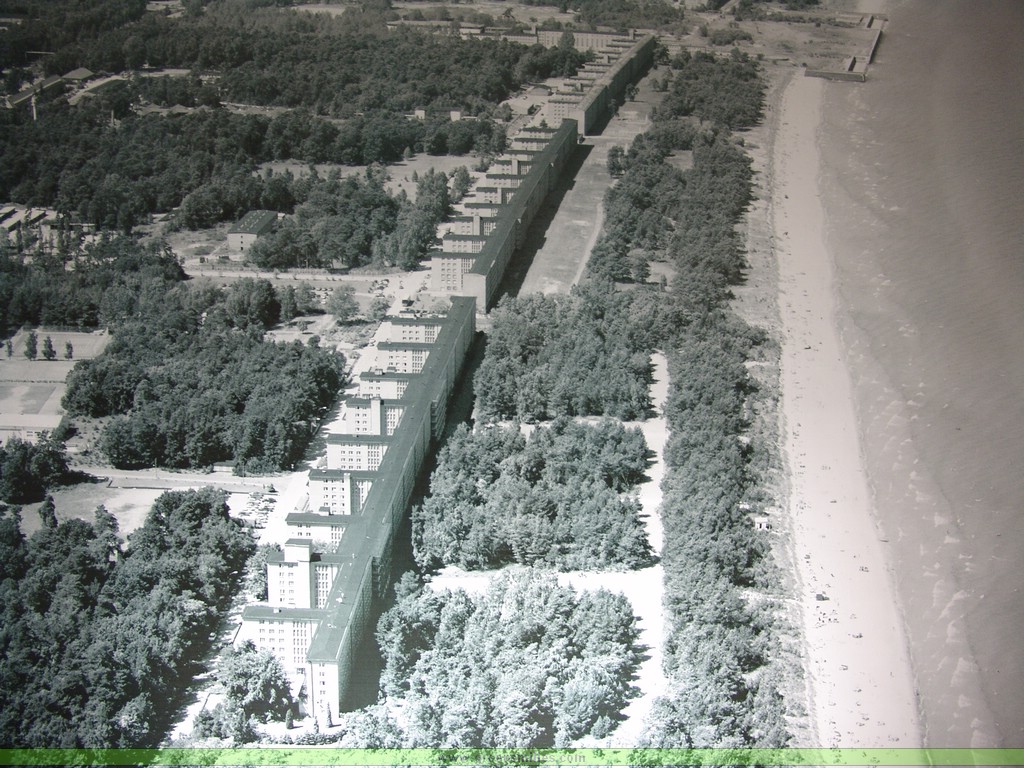
Prora is a beach resort built on the island of Rügen, Germany, known especially for its colossal Nazi-planned touristic structure. The massive building complex, built between 1936 and 1939 consists of eight identical building was planned as a holiday locale, but was never used for this purpose. Extending over a length of 4.5 kilometres in a 150 metres distance to the beach the megastructure was designed to house 20.000 holidaymakers, under the ideal that every worker deserved a holiday at the beach.

::image source
Designed by Clemens Klotz (1886-1969), the building concept was brilliantly simple, functionally thought through and also perfectly adapted to the given local circumstances: An almost five kilometer long arc. The "residential wings" stretch behind a wide promenade parallel to the beach, a gently and evenly curved bay; geometrically this makes one sixteenth of an imaginary giant circle. The center of this complex comprises a square of 400 by 600 meters. Towards the sea there is a massive quayside (with bridges for KdF cruisers) and on the opposite side the festival hall. Adjoined to the two remaining sides of this square are the six-storey "residence wings". Each of these buildings extend over more than two kilometers, containing over 7000 identical "living and sleeping cell units". All of the "cell units" allow for a view of the sea. They "measure 2.20 by 4.75 m and are all identically furnished with two beds, a washstand with running water and waterproof curtain, wardrobe (...) table, chairs and a couch".

:: image source
Each pair is connected via a communicating door, so that a six-member family could be accommodated. Furnishings, kitchenware, bedding, even the complete set of beach utensils, right down to the bathing suit, are designed according to rational principles. Towards the woods, stump-like wings are attached to the residential buildings at regular, close intervals; they contain mainly the stairwells and the bathrooms. Thus, approaching from the backside one faces an endless row of identical backyards and staircases. On the ocean side, there where ten massive, though slender "dining buildings", each seating 2000 "guests". These wings extend all the way to the water and thus divide the beach into eight, just over half a kilometer long segments - the vacationers' "home area". Here, calculations said, each guest is provided with five, or according to other calculations ten, squaremeters of the beach. Numerous secondary facilities were planned inland. Among them a train station, 5000 underground parking lots, residential areas for 2000 employees, a power station, theaters and cinemas, two indoor swimming pools with artificial waves - and a slaughterhouse.

::image source
During the few years that Prora was under construction, all major construction companies of the Reich and nearly 9,000 workers were involved in this project. With the onset of World War II construction in Prora stopped. Since future use of the still existing structure is undefined, the historic monument declines.
The Nazi-organisation Kraft durch Freude (Strength through Joy,KdF) should rise the general life standard of Germans through enabling holidays for everybody for two weeks per year considerably influenced through Nazi-propaganda. Aside from cruise trips of Kdf-built cruise ships, the construction of altogether five beach resorts - each for 20.000 people - was planned. The only partly realised of these projects was Prora.

::image source
In his highly interesting presentation at the XII Economic History Congress 2002 in Buenos Aires Hasso Spode speaks about it as the holiday machine which had nothing to do with 'blood and soil'. Instead it required cold-blooded, modern solutions. (Hasso Spode: The „seaside resort of the 20.000“: Fordism,Mass Tourism and the Third Reich). Spode gives background information on how the KdF became the word's biggest tour operator.
KdF provided indisputable evidence of how effectively the grammar of rationalization can be applied to the production of the consumer good 'holiday trips'; just as Henry Ford had demonstrated with his Tin Lizzie how one could turn an unattainable object of desire into a mass-produced article.
The Nazi version of Fordism was called 'Sozialismus der Tat' (Socialism of Deed). This term suggests that National Socialism - in contrast to the labor movement - really improves the situation of the workers, and thus makes the working class and their "Marxist ideology" obsolete.KdF established a new level of tourist behaviour: between the proletarian excursion and the distinguished bourgeois travel.
The propaganda was right in saying the KdF vacationer is a new type of vacationer and the KdF holiday, though orientated according to the bourgeois model, is a new type of holiday: less formal, less costly, less individual.

A short documentary on Prora can be found here and here (in German, but also only the footage is worth watching). This video shows how the beach resort looks today.

10 July 2009

portrait - STEINBRENER/DEMPF

Trouble in Paradise - A sunken car wreck at the rhinos, railroad tracks in the bison pen or toxic waste in the aquarium are unexpectedly interfering with our notions of idyllic wildlife. Trouble in Paradise is a temporary irritating installation in the Viennese Zoo by artists Steinbrener/Dempf.In large part, the Austrian artists deal with perception of public space. They got great attention back in 2005 with the temporary installation DELETE!, where they 'erased' any advertisment, sign, slogan, pictogram, company name in a prominent Viennese shopping street. A phenomenon we are sufficiently familar with from two-dimensional representations and photomontage works was translated f into three-dimensionality. Delettering the Public Space.
::: all images via Steinbrener/Dempf