 |
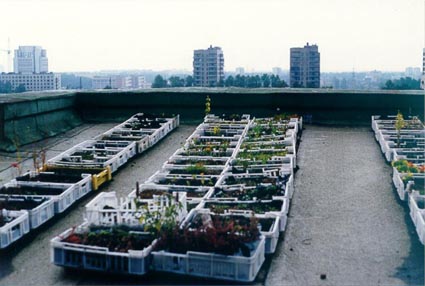
| St Petersburg rooftop.Image source. |
Showing posts with label sustainability. Show all posts
Showing posts with label sustainability. Show all posts
10 January 2012
Urban Gardening in St Petersburg, Russia
Environmental activism in post-soviet
Russia used to be the country’s most dynamic and effective forms of social
activism. In contemporary Russia, however, activists face severe obstacles in
promoting green issues. The Saint
Petersburg Urban Gardening Club, founded as early as 1993, is still
struggling with the authorities’ acknowledgments of its important work.


24 November 2011
How To Design A Thriving Community

Sustainability still is broadly examined
from the angle of environmental concerns. Nevertheless there is a growing
awareness of social sustainability amongst urban planners and architects. The Young Foundation recently
published a report commissioned jointly by the Homes and Communities Agency
as part of Future Communities
programme on the Design for Social Sustainability. On 55 pages, the report
provides ‘a framework for creating thriving communities’. In the foreword
Bartlett Professor Peter Hall
argues that under the scope of last summer’s riots in Great Britain we have
failed to create successful new communities within the existing fabric. He
further argues that “This study, which might have seemed peripheral and
academic, has become central and urgent. […] The lessons and the recommendations of this report are bound to
have a salience that its authors can never have imagined.” In relation to the
ongoing urbanization the report poses the question: how can we create new
communities in new housing developments that will flourish and succeed long
into the future? In Europe 32 new
towns are being created across 11 countries. Of course, the posed question
should not be only approached by Western cities. Some estimates suggest that in
China 100 new cities with a population more than 1 million will be created in
the next three years. For example, as part of the Expo 2010 resettlement
programme Pujang
New Town in Shanghai aims to house 500,000 new residents to create One City, Nine
Towns. Outside Seoul the Incheon Development Area will house 200,000 people
by 2010, while in Delhi four new satellite cities are being created to deal
with overcrowding and to cater for India’s growing middle classes. It presents
and will present huge challenges for governments to provide decent and
affordable private and social housing in communities that are economically,
environmentally AND socially sustainable. But this is not a new challenge. Many
projects have been developed to design out crime, incorporating social
infrastructures, considering the role local greenspaces play in wellbeing and
so on. However, many of them have failed. Partly because putting into practice
what is known is difficult, claims the report. Theoretically these approaches
work out, but practically every community is different and therefore social
sustainability cannot be prescribed in the same way as standards for environmental
sustainability. Hence, it is
crucial to incorporate the specific local conditions. However, the report argues
that planning for social success and sustainability can prevent or at least
mitigate, the likelihood of future social problems, and in many cases,
represents a fraction of the overall costs of development and long term
management. After arguing the undeniable, that social sustainability has a case,
the report defines extensively the terminology. Subsequently the Young
Foundation tries to lift the debate out of the academic arena and developed a
framework that contains four elements that are essential to build new socially
sustainable communities: amenities and social infrastructure, social and
cultural life, voice and influence, can space to grow.

What follows are the lucid diagrams
describing the four elements of the framework (All images © by The Young Foundation)


Although further research is needed in the realm of social sustainability, the Young Foundations framework might be a huge step forward on this terrain. It suggests a structured procedure which referencing for every urban planner, designer and policy maker, as these issues will be one of the main challenges of this century.
Related to this and the potential
preventions of future disasters like the recent riots read Technology
and Urban Warfare in the archive.
Is Britain becoming Los Angeles?
Recently the architect Richard
Rogers attacked the British government’s planning reforms and warned that
Britain could 'very easily' become to resemble the ghettoes of Los Angeles with
'rust belts and towns joining each other'. Cities such as Birmingham and Milton
Keynes, Bristol and Bath would also begin to merge under the current prospect
of the policies and foster an enormous sprawl. Rogers argues that 'cities are
the engines of the economy, the heart of our culture and places of innovation.
If the framework is not greatly improved it will lead to the breakdown and
fragmentation of cities and neighbourhoods as well as the erosion of the
countryside.' Until now the fears over the plans had been limited to the
countryside. Rogers is the first person to voice concern about the effect upon
major cities, as the Mail online article tells. Instead of uncontrolled
planning, Rogers pleads for the re-development of derelict areas and buildings
in the inner cities. I would doubt
that Lord Rogers also had in mind the benefit cuts that result in an exodus of
inner-city working class people to the city’s fringes, as discussed in my
recent post. Maybe I do him
injustice, but I would have reasons
to believe that he is not (always) thinking of re-developments that benefit
the socially and economically disadvantaged.
16 January 2009
WIND ENERGY REPLACES OIL FROM THE GULF

Office for Metropolitan Architecture recently has presented a masterplan for the North Sea, claiming that wind farms in the North Sea can produce as much energy as the oil from the Persian Gulf is now. The plan was inspired by Hugo Graat, who in 1609 highlited that the sea should be a binding medium between nations, enabling communicating and exchanging ideas.


 via archinect, architectenweb
24 October 2008
URBAN FOOD PRODUCTION

 Benedetta Garguilo :: Fish Faming
Here are two projects of last year's AA inter3 studio. Students were asked: Can extremes of programmatic effectiveness blend with the fragility of human habitat? Can food production be integrated into the fabric of the City?
Benedetta Garguilo dealt with fish farming in central london while Soonil Kim designed the King's Vineyard London

 Soonil Kim :: Vineyard
Thanks to pruned for the hint
related posts:
on urban agriculture here, here and here and on aqua-culture here and here
6 August 2008
JUST ANOTHER HYDRO VISION
 near-shore aqua-culture, Image by N.E.E.D
The winning entry from the South Street Seaport - Re-envisioning the Urban Edge competition is "an aquaculture-driven floating park, inlaid with combinational modules of public indoor programs." by N.E.E.D.

 Imagesby N.E.E.D
"South Street Seaport," writes N.E.E.D., "has always been closely connected with infrastructural industry of the city. Being a port and a market for fish, it actively switched its urban structure according to development of transportation modes and storing methods of goods. To continue this historical trajectory of being a highly responsive urban district, the project proposes a fish farm(works), where the future of aquaculture actuates the next transformation phase of the area."

 Imagesby N.E.E.D
Thanks to pruned and Bustler for the images.
related posts:
on urban agriculture here, here and here and recently on aqua-culture
20 July 2008
HYDRO VISONS
 A project already discussed a lot a few month ago, but worth to remember: the hydro-net vison for San Francisco 2108 by IwamotoscottArchitecture. See related article on Inhabitat.
 The architect's Flickr photo set also provides a deeper insight into to project.
While this project takes advantage out of natural processes by growing seaweed, algae and chanterelle mushroom the atmospheric physicist Carl Hodges believes that salicornia will be the natural resource for future energy supply.
 Salicornia is a crop nourished by ocean water that holds the potential to provide food and fuel to millions. See related article 'The man who farms with the sea' by LA Times
6 June 2008
WIND OF CHANGE
 Sail ships are back.
A cargo ship with wind in its sails will take to the high seas, carrying the hopes of the shipping industry for a clean and green future free from the dependency on oil.
It's no ordinary clipper replete with rigging and tons of canvas. The MV Beluga, due to sail on its maiden voyage from the German port of Bremen across the Atlantic to Venezuela, is closer to a kite-surfer on steroids. Giant sails of 160 square meters complement the Beluga's existing power plant; the more wind, the less fuel is used.
Developed by SkySail, the propulsion technology is based on a similar concept to paragliding. It consists of a towing kite with a rope, a launch and recovery system and a control system for automatic operation. With future kite sails up to 600 square meters being proposed, it will cut fuel consumption in half in the right conditions. A significant advantage of the SkySail technology is it can be retrofitted to virtually all existing cargo ships and the force it exerts is similar to that of a tug.
:: via smart planet

Subscribe to:
Posts (Atom)